

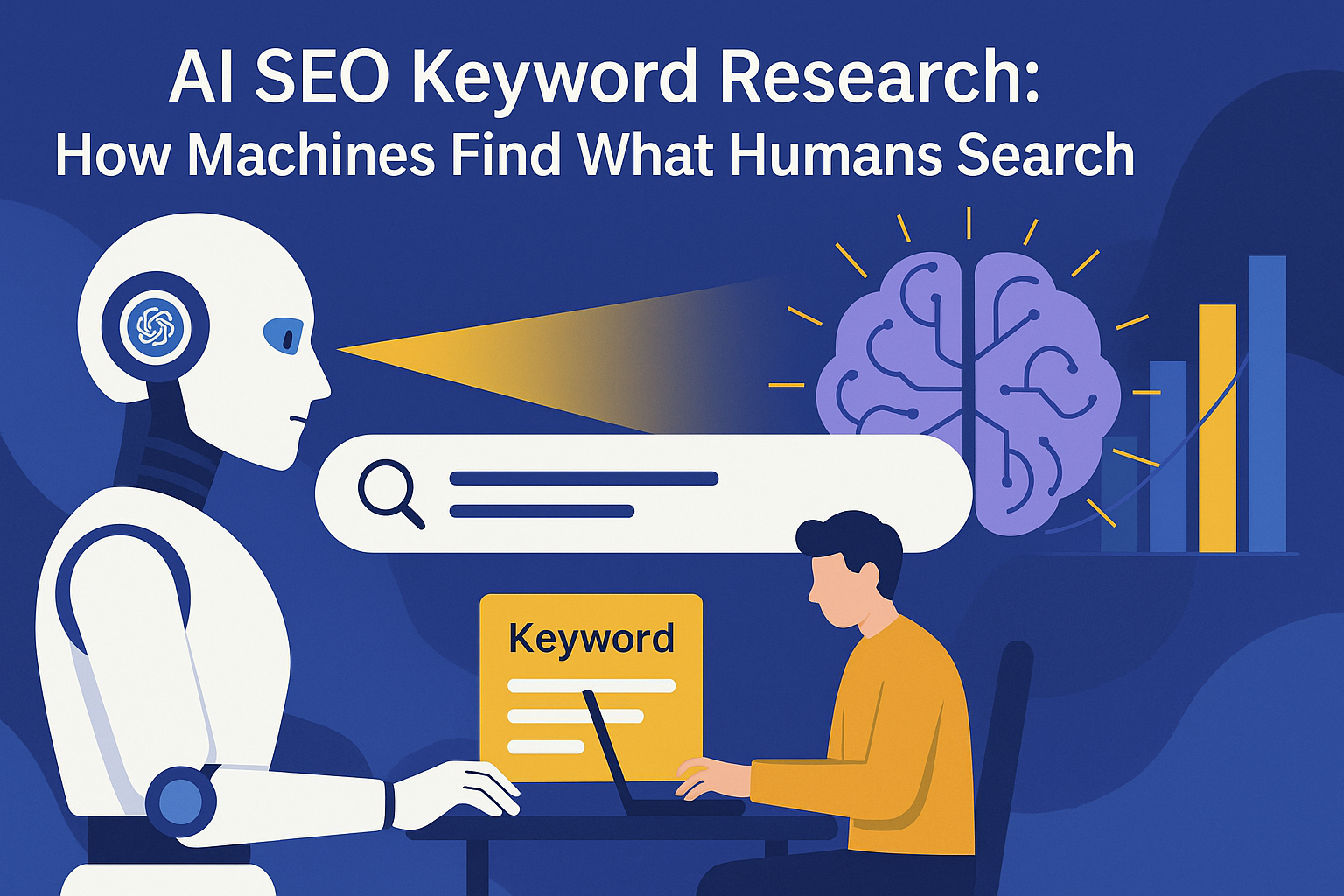
Keyword research used to be simple. Marketers opened a tool, typed a seed phrase, and built lists based on search volume and difficulty scores. But the internet no longer works in lists—it works in language. Search engines powered by artificial intelligence understand meaning, relationships, and intent instead of pure frequency.
Modern AI SEO replaces guesswork with prediction. Large language models (LLMs) process billions of search interactions to reveal what people really mean when they ask a question and what they’ll likely search next. Instead of relying on static keywords, machines now analyze semantic connections across topics, locations, and industries to surface new opportunities before they appear in traditional keyword databases.
For businesses, this evolution changes everything. It allows content teams to move from chasing traffic to forecasting demand. It also bridges the gap between human curiosity and algorithmic understanding—a concept explained further in What Is AI SEO: 2025 Guide.
Understanding Intent Prediction in AI SEO
Search intent is the “why” behind every query. AI models learn this through vast training data that includes text patterns, click behavior, and context from previous sessions. Instead of ranking pages solely for word matches, they evaluate whether the page satisfies the intent of the query.
How AI Models Interpret User Behavior
LLMs identify patterns invisible to human analysts. When a user searches “best AI SEO agency,” the system determines if the person wants comparisons, case studies, or agency listings. It connects that insight to entities—companies, tools, or topics—commonly mentioned with those words. This behavioral understanding enables content creators to craft pages that align with user motivations rather than single phrases.
Entity Associations and Topic Mapping
AI models organize terms into semantic clusters—groups of related ideas that describe one intent. For instance, “AI SEO tools,” “machine learning for ranking,” and “predictive search optimization” all belong to the same cluster. Writing content that connects these terms helps the model interpret authority.
Predictive Query Generation
Perhaps the biggest advantage is foresight. Neural networks can anticipate emerging search queries by studying conversation trends, forum data, and engagement metrics. That means marketers can produce relevant content before competitors even recognize the topic. This predictive mechanism, discussed in How LLMs Influence SEO Rankings, explains why early adopters dominate visibility in AI-powered search.
Tools and Frameworks for Machine-Led Research
The tools have evolved from static keyword explorers to AI-enhanced research ecosystems. They analyze intent, topical relevance, and probability of trend acceleration rather than only monthly volume.
AI-Enhanced Keyword Platforms
Modern platforms such as MarketMuse, Clearscope, and Surfer use natural language processing (NLP) to map semantic relevance. They don’t just list keywords; they evaluate how comprehensively a piece of content covers a topic. These tools read top-ranking pages, extract entities, and measure coverage depth. They help writers fill gaps that signal incomplete context to AI systems.
Proprietary AI SEO Frameworks
Many advanced AI SEO agencies build their own frameworks that integrate CRM data, social listening feeds, and predictive analytics. At Ferventers, internal machine-learning workflows link audience questions with performance data to reveal new search opportunities faster than standard keyword databases. This methodology, described within Ferventers’ AI SEO Services, allows small teams to scale discovery with enterprise-level precision.
Evaluating Keyword Viability
Instead of focusing on keyword difficulty, AI frameworks assess information gain—the unique value a topic adds to existing coverage. When a model identifies missing subtopics or unaddressed angles, filling those gaps can boost topical authority. It’s not about chasing volume but completing the narrative of a subject.
Collectively, these systems reduce manual guesswork and prioritize semantic alignment. The result: cleaner, more contextual keyword targeting that feeds both users and language models with clarity.
Turning AI Data into Search Insights
Raw data means nothing without interpretation. AI produces millions of term associations, but marketers must translate them into strategies that attract real audiences.
Clustering Queries by User Intent
Every search query fits one of four categories—informational, navigational, transactional, or experiential. AI automatically tags keywords accordingly, allowing teams to assign the right content type. Informational queries get blogs or guides; transactional queries get landing pages or case studies. This alignment improves both ranking and conversion rates.
Detecting Emerging Topics Early
Predictive engines flag patterns months before traditional tools. When early signs of interest appear around a topic—say, “AI SEO content optimization”—marketers can create cornerstone resources ahead of competitors. This proactive publishing model positions a brand as the first credible result once volume spikes.
Prioritizing Human-Centered Language
Machines suggest patterns; humans add empathy. While AI can cluster data, readers engage with authenticity. That’s why language tone, readability, and storytelling remain ranking factors. LLMs favor pages that balance technical accuracy with conversational clarity—an approach explored in Why AI Mentions Are the New Backlinks, which explains how contextual trust replaces mechanical metrics.
Building an AI-Driven Keyword Strategy
1. Collect semantic data: Use AI models to pull entity and intent relationships.
2. Validate human relevance: Check that each suggestion matches real-world language.
3. Integrate into content planning: Map clusters to publication dates and target personas.
4. Refresh regularly: Re-analyze quarterly to adapt to shifting query semantics.
This cycle ensures your keyword research remains predictive rather than reactive.
The Broader Impact of AI Keyword Research
AI keyword research does more than improve traffic—it reshapes SEO operations. Content teams evolve into data interpreters, combining machine learning with narrative skill. Brands can discover micro-niches faster, localize messaging automatically, and uncover long-tail opportunities hidden within natural conversation.
Moreover, predictive keyword insights feed into ad campaigns, content automation, and voice-search optimization. The same AI that identifies search patterns can personalize offers, improving ROI across marketing channels.
When combined with entity optimization, this creates a unified strategy where every piece of content reinforces expertise. Over time, consistent signals form a knowledge graph around your brand—one that both Google and generative AI models rely on to populate answers and recommendations.
Conclusion
The era of manual keyword research is over. Machines now handle discovery, prediction, and clustering with precision that no spreadsheet can match. But human understanding still guides strategy.
The most successful brands combine machine-led intelligence with human interpretation—using data to anticipate questions, create value, and speak naturally to readers.
By integrating AI-based research frameworks, semantic clustering, and ongoing validation, businesses build authority that adapts with every algorithm change.
AI keyword research isn’t just a new tool; it’s a new mindset—one that transforms SEO from chasing data to understanding people.
For ongoing insights about how AI reshapes discovery, explore Ferventers’ AI SEO Services and related guides inside the Ferventers Blog knowledge hub.