

Introduction
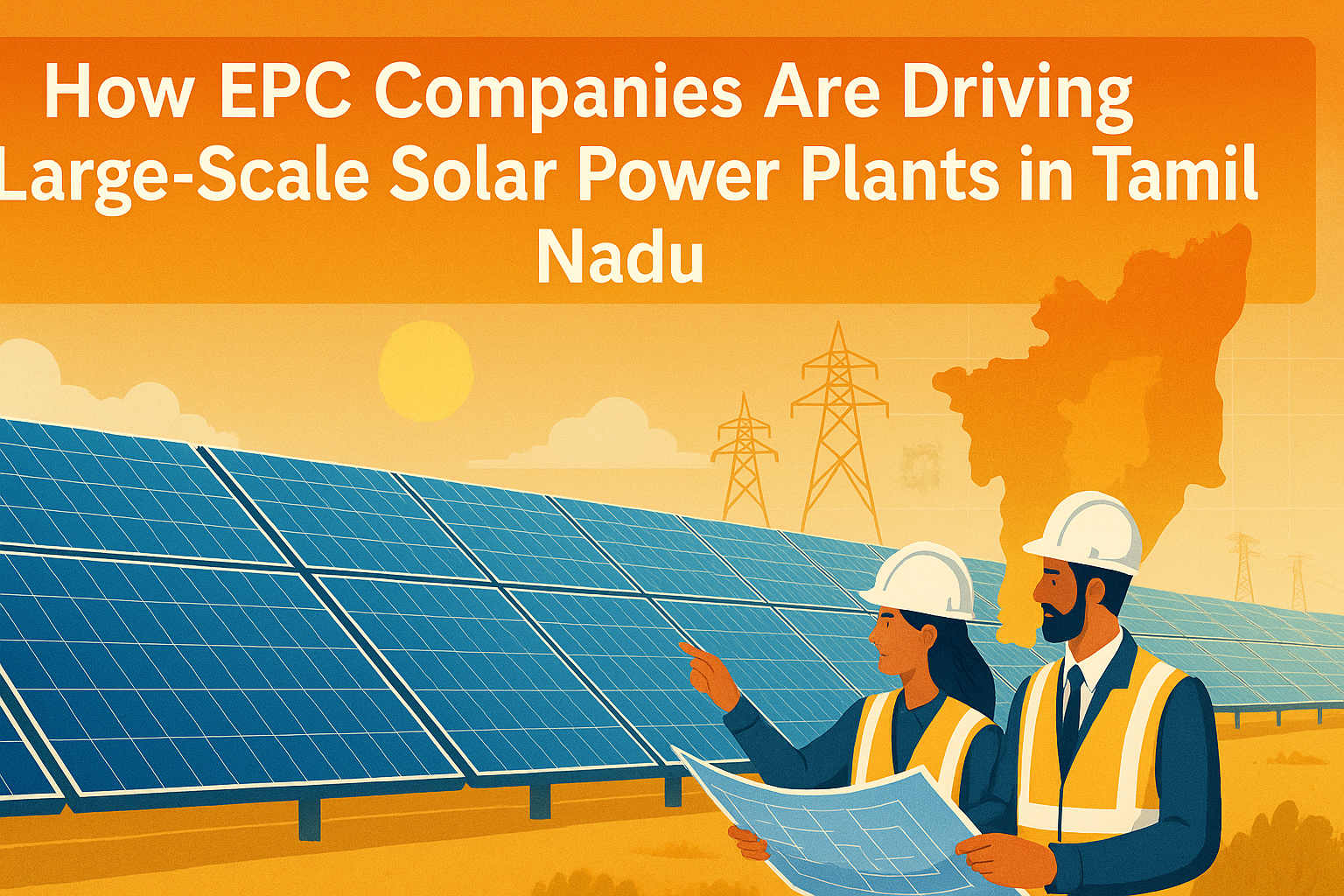
When people think about solar energy, they often picture rooftop panels on homes. But behind Tamil Nadu’s impressive renewable-energy numbers are massive power plants spread across open land, each generating enough electricity to power thousands of households.
Who makes these large systems possible? The answer lies with EPC companies — firms that handle everything from design to construction to maintenance. These solar EPC companies in Tamil Nadu are quietly shaping the state’s clean-energy future.
1. What Does “EPC”Really Mean?
“EPC” stands for Engineering, Procurement, and Construction.
- Engineering covers system design, layout, and electrical configuration.
- Procurement means sourcing the right panels, inverters, cables, and mounting structures.
- Construction includes installation, wiring, testing, and final handover.
In simple terms, an EPC company takes a project from an empty site to a fully functional solar power plant that’s connected to the grid.
To understand how smaller systems are handled, see our guide on solar panel installation in Chennai for a step-by-step view of residential installations.
2. Why EPC Companies Matter in Tamil Nadu’s Solar Boom
Tamil Nadu’s geography and infrastructure make it perfect for large-scale solar parks. The state already has vast tracts of non-agricultural land, strong sunlight year-round, and a stable power-evacuation network.
But without professional EPC partners, most of these projects would stay on paper. EPC firms handle the technical, financial, and logistical complexities that turn a concept into a running plant.
Their expertise ensures:
- Correct system sizing and layout for maximum output
- Safe civil and electrical construction
- Compliance with state and central-government regulations
- Smooth coordination with the Tamil Nadu Generation and Distribution Corporation (TANGEDCO) for grid connectivity
3. How EPC Projects Differ from Rooftop Systems
Residential solar focuses on individual roofs; EPC projects scale that idea up hundreds of times. A rooftop installation might be 5 kW, while an industrial or utility-scale plant could exceed 5 MW or even 100 MW.
The process is also different:
- Land survey and feasibility — identifying land with good solar irradiation and minimal shading.
- Design & layout — optimizing tilt angle and row spacing to avoid shadow losses.
- Procurement — ordering thousands of panels and heavy-duty inverters.
- Construction — managing civil works, cable trenches, and transformers.
- Testing & commissioning — verifying that every connection meets safety and performance standards.
For homeowners and small businesses exploring smaller systems, check solar power systems in Chennai for examples of on-grid and hybrid setups.
4. Tamil Nadu’s Advantage in the EPC Sector
Several factors make Tamil Nadu a natural leader for solar EPC work:
- Strong manufacturing base: Many solar panel manufacturers in Tamil Nadu supply components locally, reducing logistics costs.
- Port access: Easy import/export for modules and inverters via Chennai and Tuticorin ports.
- Skilled workforce: Electrical and civil engineers trained in renewable-energy projects.
- Progressive policies: State incentives encourage private participation in large-scale solar development.
These strengths allow EPC firms in Tamil Nadu to deliver faster, more cost-effective projects compared with many other regions.
5. Stages of a Large-Scale Solar EPC Project
A. Pre-Engineering & Design
Engineers perform soil tests, analyze irradiation data, and simulate energy yield. The output is a digital model showing where every panel, inverter, and cable will go.
B. Procurement & Supply Chain
EPC teams negotiate with local and international suppliers to source high-efficiency modules, weather-proof structures, and grid-compliant inverters.
C. Construction & Commissioning
This is the most visible stage — cranes lifting panels, workers assembling arrays, and transformers being installed. Once built, the plant is tested under various load conditions before grid synchronization.
D. Operation & Maintenance (O&M)
After handover, O&M teams take over to clean panels, monitor output, and handle preventive maintenance. Most EPCs offer 25-year service contracts to keep performance high.
6. Industrial and Institutional Adoption
Many industries in Tamil Nadu — textiles, manufacturing, IT parks, and educational institutions — now prefer dedicated solar plants to reduce energy expenses.
For example:
- Textile mills in Tiruppur run captive solar plants that meet daytime demand.
- Universities and hospitals operate mid-size rooftop systems to cut bills and promote sustainability.
These examples show how EPC-led projects move beyond rooftops to entire campuses and industrial estates.
To see how individual installations contribute to this shift, visit solar installation in Chennai for local-level insights.
7. Cost and Payback of Utility-Scale Solar in Tamil Nadu
The cost of a large solar power plant depends on size, location, and equipment, but utility-scale projects generally range between ₹3.5 – ₹4.5 crore per MW.
Once operational, they deliver stable power for 20–25 years with minimal running costs.
Industrial units using captive plants often achieve payback within 4–6 years through reduced grid purchases and open-access benefits.
For developers, government tenders and power-purchase agreements (PPAs) provide predictable returns over the plant’s lifetime.
8. Challenges EPC Firms Face
Even though Tamil Nadu leads in solar development, EPC companies must still manage:
- Land acquisition delays and regulatory clearances
- Supply-chain fluctuations in panel and inverter prices
- Grid-integration limits in certain districts
- Weather-related risks such as cyclones or heavy monsoons
Despite these challenges, experienced local EPCs handle projects efficiently through careful planning and strong supplier networks.
9. The Road Ahead
The future of EPC in Tamil Nadu is tied to emerging technologies:
- Hybrid solar + wind plants that balance generation throughout the year
- Battery-storage integration for better grid stability
- Floating solar on reservoirs to reduce land use
- Smart monitoring systems powered by AI for predictive maintenance
These trends will push Tamil Nadu closer to its goal of becoming a carbon-neutral state while providing steady opportunities for EPC professionals.
Conclusion
Large-scale solar power plants are the backbone of Tamil Nadu’s renewable-energy strategy, and EPC companies are the engineers behind that backbone. From design tables to dusty fields, they transform empty land into clean-power hubs that keep factories, towns, and homes running.
If you’re exploring commercial or industrial solar solutions, it’s worth connecting with experienced solar EPC companies in Tamil Nadu who can guide you through design, construction, and long-term maintenance.
Together, these experts are powering a greener and more self-reliant Tamil Nadu.