

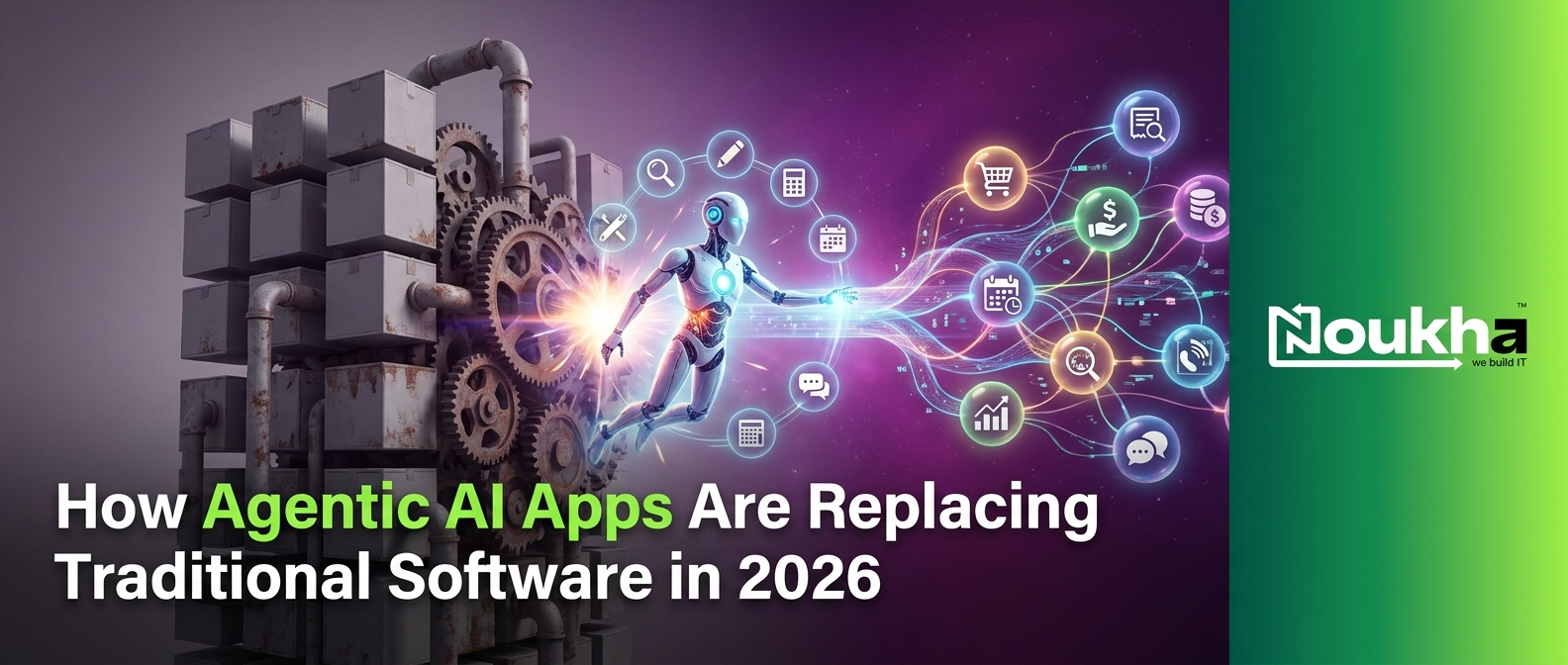
| What are agentic AI apps?
Agentic AI apps are software applications powered by autonomous AI agents that can plan, reason, and execute multi-step tasks without constant human input. Unlike traditional software that follows fixed rules, agentic apps learn from context, connect to external tools, and take independent actions to complete complex workflows. In 2026, they are actively replacing legacy enterprise software across industries including healthcare, finance, logistics, and customer service. |
Table of Contents
- The Shift from Traditional Software to Agentic AI
- What Makes an App Truly Agentic
- Industries Being Disrupted Right Now
- Agentic AI vs Traditional Apps: A Direct Comparison
- How to Transition Your Business to Agentic AI
- Frequently Asked Questions
How Agentic AI Apps Are Replacing Traditional Software in 2026
Introduction
Software has always evolved, but rarely this fast. In 2026, businesses across the United States and globally are quietly retiring legacy applications and replacing them with something fundamentally different: agentic AI apps. These are not glorified chatbots or automation scripts. They are intelligent systems capable of reasoning about tasks, using external tools, and completing multi-step workflows with minimal human oversight.
The shift is visible in the numbers. Gartner projects that 60% of new enterprise code will be AI-generated by end of 2026, while multi-agent system inquiries surged 1,445% between early 2024 and mid-2025. What began as a niche capability for tech giants is now within reach of mid-market companies and startups alike.
This guide breaks down what agentic AI apps actually are, which industries are feeling the impact most, and what it takes to build one for your business.
1. The Shift from Traditional Software to Agentic AI
Traditional software operates on deterministic logic. You write rules, users follow paths, and the system responds predictably. That model worked well for decades, but it breaks down the moment complexity enters the picture. Business processes rarely follow neat decision trees. Customer needs shift. Data arrives in unexpected formats. Exceptions multiply.
Agentic AI apps handle this differently. They are built around large language models that can interpret instructions in natural language, reason through ambiguous situations, and call external APIs or tools to gather what they need. An agentic app handling customer support does not just search a FAQ database. It reads the customer’s history, checks the order system, drafts a response, and, if needed, escalates to a human with a pre-written summary.
This capacity for contextual reasoning is what separates agentic software from the automation tools of the previous decade. RPA tools followed scripts. Agentic AI apps follow intent.
2. What Makes an App Truly Agentic
The word agentic gets applied loosely in marketing, so it helps to know what the term actually requires technically. A genuine agentic AI application has four core characteristics:
- Goal-directed planning: the system can break a high-level objective into executable steps without being told each step explicitly
- Tool use: the agent can call external APIs, query databases, browse the web, write and run code, or send communications
- Memory and context retention: the agent tracks what has happened earlier in a session to inform decisions
- Autonomous recovery: when a step fails, the agent diagnoses why and attempts an alternative approach rather than simply stopping
Apps that only do one of these things are still valuable, but they are AI-assisted tools rather than agentic systems. The distinction matters when scoping a development project, because the architectural requirements are substantially different.
Building a truly agentic app requires orchestration logic, robust tool integrations, careful prompt engineering, and a safety layer to prevent unintended actions. Teams that have built scalable agentic products for the US market, like those offering dedicated
Building a truly agentic app requires orchestration logic, robust tool integrations, careful prompt engineering, and a safety layer to prevent unintended actions. Teams specializing in AI app development in the USA tend to have this multi-layer architecture down to a repeatable process, which shortens delivery timelines considerably.
3. Industries Being Disrupted Right Now
Agentic AI is not hitting every sector equally. The disruption is concentrated in industries where knowledge work is high-volume, repetitive, and context-sensitive.
Healthcare
AI agents are handling prior authorization workflows, summarizing patient histories for clinicians, and managing appointment scheduling. The manual effort involved in these tasks was enormous, and errors were costly.
Financial Services
Banks and fintech companies are deploying agentic apps for fraud investigation, loan underwriting assistance, and regulatory compliance monitoring. These tasks require reading documents, cross-referencing data sources, and flagging anomalies, all things agentic systems do well.
Logistics and Supply Chain
Routing optimization, supplier communication, and inventory forecasting are being handed to AI agents that can process real-time data and update plans without waiting for a weekly report.
Legal and Professional Services
Contract review, due diligence research, and document drafting are increasingly handled by agentic tools that cut turnaround times from days to hours.
4. Agentic AI vs Traditional Apps: A Direct Comparison
| Feature | Traditional Software | Agentic AI App |
| Decision logic | Hardcoded rules | Context-aware reasoning |
| Handles ambiguity | Poorly or not at all | Interprets intent and adapts |
| Tool integration | Manual API setup | Dynamic tool calling |
| Exception handling | Requires human review | Self-recovers or escalates intelligently |
| Update cycle | Requires code releases | Learns from prompts and fine-tuning |
| Cost over time | High maintenance overhead | Scales without proportional cost increase |
5. How to Transition Your Business to Agentic AI
Moving from traditional software to agentic AI does not have to be a big-bang replacement. Most successful transitions follow a phased approach:
- Identify the right process first. Start with workflows that are high-volume, involve unstructured data, and currently require significant human decision-making.
- Build a minimum viable agent. Scope a narrow version of the workflow and deploy it with a human in the loop before going fully autonomous.
- Integrate with your existing stack. The best agentic apps work alongside your CRM, ERP, or ticketing system, not in isolation.
- Build the safety layer. Define what the agent is never allowed to do autonomously and set up audit trails from day one.
For companies that want cost-efficient agentic AI development without sacrificing quality, partnering with an experienced AI development company in India gives you access to deep AI engineering expertise at a fraction of US in-house build costs.
Frequently Asked Questions
Q1. Are agentic AI apps safe to deploy in regulated industries?
Yes, but they require a governance layer. This includes audit logs, human escalation triggers, and defined boundaries on what the agent can act on autonomously. Regulated sectors like healthcare and finance are already deploying them with these controls in place.
Q2. How much does it cost to build an agentic AI app?
A focused single-workflow agent typically ranges from $30,000 to $150,000 USD for initial development, with ongoing optimization costs that reduce over time as the system stabilizes.
Q3. Can agentic apps work with my existing software stack?
In most cases, yes. Modern agentic frameworks are designed to integrate with REST APIs, databases, and standard enterprise software. The integration layer is often the most time-consuming part of development but is entirely solvable with experienced teams.
Q4. What is the difference between an agentic AI app and an AI chatbot?
A chatbot responds to queries in conversation. An agentic app takes action. It can call external systems, run code, update records, and complete multi-step tasks. The chatbot is reactive; the agentic app is proactive and task-driven.
Q5. How long does it take to build and deploy an agentic AI application?
A focused MVP typically takes 8 to 16 weeks depending on integration complexity. Full production deployments with custom fine-tuning and enterprise-grade safety controls generally take 4 to 6 months.
Conclusion
Agentic AI apps represent a genuine architectural shift in how software operates, not just a feature upgrade. The businesses adopting them in 2026 are not chasing trends; they are solving real operational problems in ways that traditional code simply cannot match. The entry point does not have to be massive. A well-scoped first agent, built on the right foundation, often becomes the most valuable piece of infrastructure a company owns within two years.
If your business is evaluating where to start, the best first step is identifying one process that is painful, high-volume, and currently dependent on human judgment. Build there first, measure the impact, and expand from what works.
About the Author
| Ramanathan Alagappan
Founder and CEO, Noukha Technologies Ramanathan Alagappan is the Founder and CEO of Noukha Technologies, bringing 13+ years of experience in product engineering and technology leadership. With a background spanning senior engineering and CTO roles, he has built and scaled products from zero to one, primarily in SaaS and platform-driven environments. His current focus is on AI-powered systems and scalable software architectures that help businesses ship reliable, production-ready products. |